Showing posts with label Toddlers and Up. Show all posts

Monday, August 22, 2011

DryErase ABC Book

I am always looking for new ways to introduce my kids to the alphabet, numbers and other topics. Awhile ago I read about using a photo album to create a picture book. I thought it sounded like a nice way to create a toy/activity for my kids that could be personalized to them or to a concept I wanted to teach.

I decided to make more than just a picture book. I figured why not make a reusable coloring ABC book. So that is what I did.

Materials Needed:

photo album (I got mine at the dollar store)

scissors


* I made these printables myself. Feel free to use them or just use them as a sample and make your own. I promise I won't be offended.

This is so simple to make. If you use the printables it will only take about 20 minutes - enough time to cut out the pictures and put them in the book.

Step 1:
Cut out the pictures.


Step 2:
Insert pictures into the photo album


Optional:
Insert cover


Step 3:
Hand book and crayons (dryerase markers can also be used) to your child and let them color away.


I told you this would be an easy project. My son LOVES this book. We talk about the letters and their sounds as he colors. I am also hoping that he will learn some new vocabulary words - like octopus and quail.

 I like that it is small enough to fit into the diaper bag. I plan on using when we are out on errands that require a lot of waiting (doctor visits, anything to a government office).


I hope you like this idea. It is a really inexpensive way to introduce the ABCs and have fun with your kids.

Let us know if you have any fun teaching ideas or projects for kids.
I am always on the hunt for new ideas!

~Lisa~


Friday, August 19, 2011

Bring On The Play Dates


It's never too early to arrange play dates.  I love them.  Play dates are fun for me, my child gains valuable social skills, and spending time with other human beings make those long hours before my husband gets home fly like nothing else.  There's only so many conversations I can have with my toddler before I start itching to hear complete sentences.  But remember, play dates are more than scheduling a time, date, and a place on your little sweetum's social calendar...there's etiquette, inevitable problems, and all sorts of things to consider.

THINGS TO CONSIDER:

Age:  In the beginning, play dates may be more for the society-deprieved young mother than a small baby, but it's never too early to start.  Babies are fascinated by other babies.  I remember my child progressed through milestones leaps and bounds faster after watching other kids roll, crawl, and walk around him.  If your toddler is one of those that prefer playing alone, never fear.  They'll still value the time spent in another kid's company.  Co-playing will come easier as they get older, usually between ages 3-5.

Gender:  Doesn't really matter with young toddlers.  If anything, play dates are an excellent opportunity to spend time with a child of the other gender.  My two year old son's temperament is super mellow, so he actually plays better with girls than he does with most rough-housing boys.  When gender DOES start to matter, your child will let you know.

Frequency:  I have a three month old baby as well as a toddler, so once a week is about all I care to pack up the kids for.  Other mothers with more mobile kids seem to reach a general consensus that twice a week is a good number for planning social times as well as keeping the general routine of the house in-tact.  On the other hand, especially busy mothers are hard-pressed to make a play date work once every couple weeks.  The important thing is to cater it to your schedule. Whatever works for you and your family and doesn't stress you out.

Location:  Because my toddler is two and a half and prone to meltdowns in confined spaces, location is a big issue for me.  My friend and I discovered just last week that the library is NOT a good place to take toddler friends.  They just wanted to run around, yell, jump on kiddy-size furniture, and be toddlers in general.  Since then, we've stuck to parks, playcenters, and each other's houses.  Full-on excursions will have to wait for when the kids are older.

Length:  Two hours is about the point of no return for my kiddos.  Anything too far beyond that makes for overtired, overstressed, overplayed children that are a BEAST to put down for a nap later on.  And I mean that with all the motherly love I've got in me.  I've found that play dates work best when we semi-structure out different activities.  Play time.  Snack.  Activity.  Play time.  Pack up.  Leave.  Switching up what the kids are doing will help keep them from getting bored and frustrated with each other.

Reciprocate:  If one mom hosts a play date at her house, make sure you do the same for her.  It's just the right thing to do.

COMMON PROBLEMS:

Now, all that said, play dates don't come without problems.  One common one is SHARING...(oh the never ending battle) toys, food, mommies, babies, you name it...if a playmate has it, the other kid wants it. Sometimes it helps to narrate the situation.  Get your child used to the idea of someone coming over to play by giving him a heads up before Johnny comes over.  Once Johnny gets there, physically take and hand the toys between the toddlers (at good transition points) and explain that both of them get to play with it when it's their turn.

Another problem is SHY children.  You go through all the trouble of arranging a play date, but your little angel sticks to you like glue.  Sigh.  Is the play date even worth it?  Yes!  Keep at it.  Ask your mother-friends for help and explain the situation.  As much as possible, you want your toddler to practice getting used to other people with the comforting feeling that mommy's close by.  Try to be there without getting in the middle of it.  Let your child explore their own creativity.  The last thing you want to do is avoid play dates altogether.  Let's just say...avoiding social time is going to make preschool REALLY shocking for your child.

So, I turn the time over to you ladies.  How often do you schedule play dates?  What do you usually do (for what ages)?  And how do you deal with the problems listed above?  My boy is one that's a little shy around other kids...especially if there's A LOT of other kids, like at a play center.  Please share your fabulous advice!  I appreciate your feedback.  Thanks, gals!

-Alyssa

Thursday, August 18, 2011

It's that Time Again

Back to school! Since this is the first time I will be sending a child to school, well preschool, I'm wondering what I need to do to help my little guy be ready to go.  We've talked about how next week he will get to meet his teachers and then start school. Luckily he is pretty comfortable with one of his teachers as she is in our ward and he plays with her 3 year old. But I'm wondering if there is anything else I should talk to him about or prepare him for, any suggestions from you smart moms?

-Megan-

Friday, August 12, 2011

To Share a Room, Or Not Share a Room...


That's the big question at my house this month.  Reasons for room sharing are vast, but most center largely on two factors, (a) necessity, there just aren't enough rooms in the house and (b) the parents want siblings co-exist in the same room to build better relationships.  Which is better? Well, it depends.  Here are some pros and cons to consider.

THE UP SIDE

The most obvious benefit is that kids learn to live with someone else.  They learn to negotiate decorating a room together and cleaning when one child is messier than the other (ehem, good practice for marriage, perhaps).  Good behavior can also rub off on the other child, like seeing a sibling reading, or drawing, or investigating sciency-stuff in their room.  And finally, parents of room-sharing kids often say that the biggest plus is that at night time, when dark shadows and overactive imaginations bring out worry in some kids and they don't like to be alone, having another sibling close by quells some of the night time fear.

THE DOWNSIDE

On the other hand, I shared a room with my sister growing up, and I can attest that with regards to room maintenance, bad behavior rubbed off more than good.  You would think that one of us would be cleaner than the other, but we seemed to augment each other's hurricane of clothes, books, toys, and trinkets on the floor until seeing the carpet was nigh near impossible.  My dad would have to threaten to throw all our stuff in the dumpster to jump start our bi-monthly room cleaning extravaganza.

Other parents complain of children waking and keeping each other up during the night.  Some kids spur competition, ("I want a drink."  "Me too!"  "I need to go potty."  "ME TOO!") making bed time practically impossible.   This not-so-good bed time behavior is clearly not constructive or helpful in relieving bed time headaches.

As kids get older, the biggest drawback may be privacy.  If y'all remember growing up, having an ALONE space to go to was sometimes very necessary.

SO, WHAT TO DO

None of the downsides have to keep your kids from sharing a room.  If space is limited...well, there's not much logical reasoning that can do anything about that.  Room sharing will have to happen, but bringing all the variables into the decision may change subtle nuiances of how you go about doing it..  Experts do advise though with older children, if room-sharing and single rooms are both an option, to bring the kids in on the decision making process.  Kids know best whether or not their sibling friendship can stand the test of sharing a room.  You might want to try a weekend sleepover to see if it works!

MY REAL-LIFE SITUATION

My kids are NOT in the rational, "older" kids category to have a discussion with.  My boy is two.  My baby's 3 months.  We don't have room for them NOT to share a room, and I want my baby out of my room.  Neither of us is getting good sleep with things as they are.  My kids will have to share a room.
 I'm just not sure how to get things rolling.

So, what are your thoughts?  What do you remember (pros and cons) of sharing a room with your sibling?  For those of you with kids, what kept you from putting them in the same room?  At the same time, for parents who have kids sharing a room, how did you do it?  I need help.  I don't see how it'll work.  My toddler will SO wake my baby up any chance he gets.  Not good.  I really appreciate your comments.  Thanks much!

-Alyssa


Thursday, August 11, 2011

Scaredy Cat!!


Friday night we went up to my in-laws for dinner. This spring they decided to try raising chickens and the chickens are left out to roam the yard. Well, one of their roosters attacked Lucas. He had a couple of scrapes on his shoulder but was other wise all right. However, because family from out of town is visiting we were back up there again on Sunday and Lucas is now afraid of the chickens. Whenever one gets close to him, he runs in the other direction or to the closest adult. I understand his fear, I was attacked by a rooster when I was around his age and didn't like chickens for a long time either, but I don't want him to be afraid of them because then he doesn't want to be out in grandma and grandpa's yard. We can't put the chickens in a pen because they are free ranging chickens and are only locked up at night. So, any suggestions on helping a child scared of an animal?

- Megan -

Friday, August 5, 2011

Best Books to Read to Toddlers

Reading to your children is one of those foundation activities that every parent should do.  I'm usually a bit cautious making grand statements like this, but in this case, every expert on the planet will agree it's absolutely true.  Why?
  • A parent reading to her child introduces vital language skills.  If mommy reads, then children are drawn to the idea that letters and words work together to make something important to pay attention to.  We've all been through years of school and life, and we all know, being able to read can make or break you in this world.  Our job as parents is to prepare our kids for adult life, and let's be honest; reading skills are a vital part of that.
  • Reading can open new worlds.  Cheesy?  Maybe, but it's absolutely true.  Reading is a sure-fire way to introduce new ideas, encourage learning more advanced vocabulary, and foster a curiousity for learning that just doesn't come up in a normal, home atmosphere without books.
  • Reading time is precious social time with mommy and daddy.  We're busy.  We all know that.  I feel like I'm going a hundred miles an hour all day, but taking time to slow down, relax, and read to your children will make special memories that'll mean the world to them.  Your small sacrifice of 15 to 30 minutes a day will be paid back a hundred-fold.  I promise.  I still remember hearing my father's voice as he read to me all those years ago.
Now, I'm not even going to pretend to start an all-exhaustive list, but there are a few books that ALWAYS come up in my boy's "must read" pile during his pre-bed and pre-nap reading times.  (Keep in mind, he's two and half.)


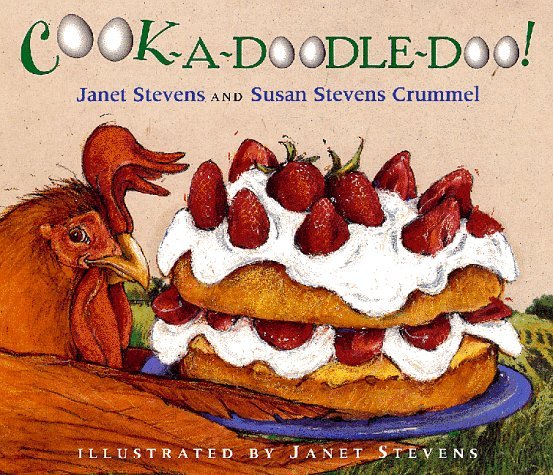
"Cook-A-Doodle-Doo!" is a to-die-for adorable book about the Little Red Hen's great-grandson who decides he's sick of eating chicken feed and wants to try out cooking like his great granny.  The story is clever.  The writing introduces simple cooking terminology in a GENIUS and incredibly fun way.  The dialogue between the characters made my husband burst out laughing.  And the art is absolutely gorgeous.  (If you know me, I'm a sucker for great illustrations.)  I didn't have this one growing up, but I completely adore it now. 


This is one I grew up with.  "The Little Mouse, The Red Ripe Strawberry, and The Big Hungry Bear," (besides having the longest title ever) is one of the funnest books to read to toddlers.  The story is about a little mouse who, after picking a strawberry, goes about different methods of hiding it from the bear.  The writing is, again, genius.  My boy can hardly stand the suspense of what's going to happen to the poor strawberry (even after the hundreth reading).  And once again, the illustrations are gorgeous.


A classic, am I right?  "Each Peach Pear Plum" makes a fantastic I-spy game out of beloved nursery characters all while subtly introducing words the rhyme.


"There's a Wocket in my Pocket" is one of Dr. Seuss's many gems.  I love this one, because it's simply written (some of Seuss's books can get a little wordy for a toddler) and is a great introduction to rhyming.  My boy likes it because all the wacky Suess-animals are in familiar settings he recognizes, like under the table, on the ceiling, on the couch, etc.  Being able to recognize stuff is exciting for a two year old who is just getting a grasp on language.


Oh, another classic.  My boy ADORES this book.  It's an absolutely fantastic way to drill colors without your kid knowing what you're up to. :)  Meanwhile, all the familiar animals make my child excited to keep turning pages.


My boy loves the entire series by Laura Numeroff.  Again, it's the recognition thing.  He loves being able to point out things he recognizes, like pancakes, taking a bath, and dancing that all happen in this book.  He gets so excited, and I can totally use that recognition to my advantage.  "Look, the pig is taking a bath!  What letter does bath start with?" I ask him.  "B!" he yells, jumping up and down.  Using familiar words to drill letters is a great way to get todders interested in reading.


Short and sweet.  This is the first book I ever bought for my child.  In just a handful of pages, "The Little Engine That Could" by Piper Watty tells a wonderful story about how anything is possible if you believe in yourself.  What a great lesson to teach your children.

And these are just the tip of the iceberg.  There are SO many good books out there.  What are your favorites?  Why are they so good (aka what lessons do they brilliantly teach)?  I'd love to hear some excellent tips for new books to try out.  I bet with all of us, we can come up with a pretty fantastic list. :)

-Alyssa

Thursday, July 21, 2011

Not so Good

Yesterday we went to the park and had a fun time until the very end.  I was packing everything up to take to the car and then walking to the other end of the park to get Lucas when I noticed a woman walking him towards me.  I was a little concerned because I hadn't seen Lucas do anything naughty and then he got within hearing distance of me and was saying something I have never heard from his mouth before, a swear word (thank you family member that I will not name!). This woman, I don't know if she had kids or not because me and a friend could only see our kids, glared at me like I was the most horrible mother in the world! I quickly stopped Lucas from saying what he was and apologized to her and had Lucas apologize also.  She didn't say anything so I walked away. So I have a couple questions for this situation to ask you smart moms out there.

First, what discipline do you use when your children use not so nice language?
How do you deal with the situation so it doesn't happen again?
Have you approached the person they learned the language from and discussed it with them?
Besides apologizing to the woman, was there anything else I should have said?

-Megan-

Friday, July 8, 2011

Teaching Your Child The Alphabet


I felt pressured to be the BEST mom. There's just so much mothers need to teach their kids.  As a first time mother, I felt overwhelmed.  For starters, how on earth was I supposed to start teaching my boy his alphabet?  I didn't even know where to start.

I knew that on the developmental track, being able to recognize a handful of letters by age 2-3 and most of the alphabet by age 4-5 was within the realm of normal, so I didn't necessarily HAVE to force alphabet learning on my two year old son.  By all accounts, he seemed completely uninterested, and I knew it might be better just to back off for a while*.   But still, I felt pressure to try out different teaching methods.  I mean, maybe I just hadn't hit upon his learning style yet, right?

There are a lot fun ways to introduce the alphabet:

  • Sign his name onto EVERYTHING.  His bed.  His sippy.  His artwork.  The door to his room.  Sound it out for him and point out the letters.  Eventually he'll get the idea that those letters work together to make a word.
  • Help him play with alphabet puzzles or refrigerator magnets.
  • Keep reading to him!  And point out specific letters for him.  Focus on a few letters per week.
  • Once he starts recognizing letters, play word games like "What words begin with B?  Ball, boy, baby..." or if he's especially attached to the letters in his name (like my child), use those letters as a starting point.  "Your name has a special letter M in it?  Can you think of any other M words?"  You can also make simple letter-word matching games on flashcards (Letter M matches to a picture of Mommy, the letter P matches to a picture of pancakes, etc.)

I tried a bunch of different method, but kids have a funny way of being perfectly unique.  My son was incredibly active, uninterested in listening to me "talk" at him about letters, and had the attention span of a chipmunk...unless he was watching PBS television shows.  THEN he would sit still for a whole 15-30 min while the episode flashed across the screen.

And then we stumbled upon a learning dvd, The Letter Factory, by Leap Frog.  If your child is one that will sit still for TV, it can be a powerful learning tool.  The Letter Factory is formatted well so that even if your child won't sit still for the whole 35 minute movie, each segment on each letter is relatively stand-alone, so he doesn't have to finish the movie to get the learning going.  My son learned ALL the alphabet, upper and lowercase, and ALL of their sounds in two weeks.  I was astounded.  The Letter Factory has gotten rave reviews across the board ever since it came out a decade ago.  If you haven't tried it, I'd recommend borrowing it from a friend and giving it a go.  See how your child takes to it.


So, the DVD worked magic on my child, but he's the type of kid that would rather watch "things" (like TV or battery-powered toys) than people.  Remember, every kid has a different learning method.  I imagine if my boy was more of a social type, he would have enjoyed discussing letters with mommy a little more.  So, what kind of methods have you used?  What has been effective?  What was ineffective?  For those of you with more than one child, have you noticed a difference in how each of your kids took to learning the alphabet?  Make sure you describe your child's personality as well, so other moms have a starting point to get ideas for their own kids alphabet learning!

Thanks y'all!

-Alyssa

*Special Note:  This is an idea forum...not a guilt trip generator.  If your child is under age 4 and shows no interest in letters, don't worry.  Child development experts say that there's little correlation between early alphabet learning and super advanced reading skills later on, so if your child is still young and uninterested, it might be best to let it go for a while.  We all know kids are geniuses, and there's just a lot for a toddler to learn.  He might be trying to figure out something else right now.

Thursday, June 23, 2011

It Comes with the Territory


 Okay, I know we have talked about potty training several times but one aspect that I haven't seen addressed in our previous posts was constipation I know this isn't a fun topic, but we are currently combating this issue at my house and having several problems with it.  I've talked to our pediatrician and all the non-medication remedies that he suggested haven't worked.  Before I start putting my child on miralax, I wanted to ask all you smart moms out there who have dealt with this issue what you have done!

We tried the prune juice, increasing his water intake, changing up his diet to include more fiber, and decreasing the amount of dairy products he eats and nothing has worked so far!  We still end up with the same result of messed underwear. So, if you have any other ideas for what we could try please leave a comment!

- Megan -

Tuesday, May 3, 2011

Kid Time: 1+1+1=1

Hey everyone! Today for our Kid Time post I wanted to tell you all about a blog I absolutely LOVE for great ideas for kids as young as 10 months all the way up through elementary age.


1+1+1=1

This blog is written by Carisa, a public school teacher turned homeschooling mom. Through her experiences homeschooling she has come up with some really creative and age appropriate ways to encourage young kids to learn through exploration and mommy-led activities.


Tot School is her name for intentionally playing with her toddler. In other words, Tot School is the when you just focus on your toddler and play with them. You choose toys that you use to teach various concepts such as colors, letters, sorting, etc.

I have loved planning tot school with my son. Some days it is just playing with blocks and sorting them by colors or lining them up and counting them.


My little girl even got in on the action when she was about five months old.
(Really, it was just tummy time, but on a new play mat.)

Other days, our tot school is a little more formal. We might practice cutting, gluing, or pouring. These are activities that I wouldn't normally let my son do, but because it is a structured setting I make an exception. I will admit that these are some of my favorite days.

Lately, we have been using Carisa's Tot School Printables.

Slide1
Slide6


Slide13

Carisa's printables focus on:

letters

beginning sounds

sequencing

concept of left to right

shapes

numbers

Carisa has so much information and so many ideas that it is hard to do her blog and accompanying website justice.

She has created Preschool Pack and Tot School Packs which are kind of like file folder games, but more inclusive.

Here are some examples:

Toy Story


Her Preschool Packs cover so many themes, including:

Cars

Princesses

Gardening

Books (like Brown Bear, Brown Bear)

and SO,SO, SO much more.

I promise that if you visit her website you WILL find something that you like. Don't be surprised if you find a ton of things you like.

Most of her printables are totally FREE because she wants to give other moms a chance to use them.

(She does have a Members Only section with even more incredible resources that you can join for a very small price.)

Carisa has done a lot of work in putting together her ideas and organizing them for other moms to use. I love that her ideas all came out of her desire to teach her children. I felt that a great way to say THANK YOU was to pass on her information to all of you.

Check out her blog. You will not be disappointed!

Lisa


Tuesday, April 26, 2011

Toddler Learning Activity: EGG-cellent Color Relay


Wait! Wait!  Don't pack up those Easter eggs yet!  We've got plans for a game involving everyone's favorite plastic egg for easy, inexpensive, color learning fun!

THINGS YOU'LL NEED:

Pack of plastic Easter eggs 
(about one per kid...get them on sale now if you don't have enough)
Paper to match the color of your eggs 
(pick em' out for free in the paint section of Lowe's or Home Depot)
Large bowls or laundry baskets
Timer (optional)


First, lay out your bowls and tape colored paper to the bottom of each.  Divide in half.  Set Mommy's bowls on one side of the room, and your toddler's bowls on the other.  Say, Mommy gets green and pink, while your toddler gets blue and yellow.  Dump out the eggs and explain the rules of the game:

(1) Match the eggs to the right color bowl.
(2) Whoever collects three eggs of the right color first, WINS!

This game is a great review of simple counting, as well as color drilling.  The first few run-throughs will be trial-and-error.  Heck, maybe ALL of them will be.  After all the eggs are collected, help your toddler sort through her eggs and reshuffle any eggs that got put in the wrong color bowl.  I'm not kidding when I say my boy and I did this, over and over, for AN HOUR.  Seriously.  What game can hold a toddler's attention for that long?  The kind that lets him run around and throw eggs, that's what.  The great thing about the materials we're using is that plastic Easter eggs pop open if tossed too hard, so very little damage ever happens in the whole, exciting process.

TIPS/SUGGESTIONS:

For older children, increase the number of eggs that need to be collected.  Also, set a timer and perhaps sit out completely, pitting kid against timer in an epic Easter egg color battle.

For younger children, you can try taking out some complexity at first by simplifying the number of colors they're dealing with.  Say, one color for Mommy and one color for the toddler.  Makes it a lot easier, because blue/purple and pink/peach look pretty similar sometimes.

...And let's be honest, if the game quickly dissolves into something like this...


That's okay!  Because play time is learning time, and it can't get much better than this. :)

-Alyssa


-Original idea developed by yours truly and my little boy.  Take it, and run with it!  Please don't forget to share comments of any variations you come up with on the Village blog!

Tuesday, April 19, 2011

Toddler Learning Activity: Sewing

Break out those egg cartons.  It's Easter Time!  And I know we'll all have mountains of those things lying around after eggs are all dyed and tucked into the refrigerator for Easter morning.  But then, what do you do with all the cartons?  Look no farther, my friends.  We've got a lesson in toddler-friendly sewing!

THINGS YOU'LL NEED:
Egg carton
Exacto knife
Ribbon or twine
Paper clip

First, cut off the lid and little edge-piece.  You want the bottom part, clutter-free.

Next, cut random holes in the bottom of the carton.

Tie one end of the ribbon to the carton the other end to a paper clip.  I eyeballed the length to my toddler's arm-span.  Too long will make it difficult to sew.  Too short won't leave much ribbon to sew with.

TIP:  Use a brightly colored ribbon so your toddler can see what he's doing.  I'd actually recommend using a thicker piece of ribbon than what I've shown here, so the "needlework" is more noticeable to your little seamster/seamstress once the sewing project has begun.

And let me tell you, it was a riot...the low-key variety.  After all, sewing takes a lot of concentration.

It was fun to see him start to get the concept of threading the ribbon through holes.

TIPS/SUGGESTIONS:
For younger toddlers who may have difficulty grasping the paperclip, try tying the ribbon to a baby spoon instead.  Easier to grab.  Same general concept.

Let your toddler be creative and experiment with this activity.

Once your toddler is done, set the sewing project aside to show Mommy or Daddy later on, and lavish on that praise!

-Alyssa


-Original idea from www.toddlertoddler.com


Tuesday, April 12, 2011

Toddler Learning Activity: Wind and Pinwheels

Spring is upon us, and with it, awesome changes in the weather to talk about with your kids!  Wind is a fun one.  A little more complicated than snow or rain, because your toddler can't see or touch it, but still a great weather phenomenon to explore.

A pinwheel is a sure-fire hit with kids of all ages.  I remember making pinwheels just for fun when I was in my tweens.  During your wind exploration, try introducing new vocabulary like air, breeze, float, fly, gentle, strong, gust, soft, and (if you use my wind-making cheat below) the difference between hot and cold air.  Experiment with different sizes of pinwheels.  Big ones.  Small ones.  How do they react to the wind?  With older kids, explore how different speeds of air move the pinwheel.    So many questions, so much to explore!

SUPPLIES NEEDED:
Paper
Exacto-knife or scissors
Stick pin
Pencil w/eraser
Pattern (optional)

First, cut a square.  Draw diagonal, criss-cross lines from one corner to the other.

Mine's a 4x4 inch square.

Exacto-knife it part-way through.  Poke holes in the center and in each corner to make the pinwheel turn easier once it's assembled.

Ready the rest of the supplies, aka a pencil w/eraser and a stick pin (I used a picture-hanging nail, because I was fresh out of pins).

Gently bend half of the corners in and secure it with the pin.  Push the back of the pin into the pencil eraser.

Viola.  Instant toy.

The beauty of a wind toy is that it shows that the air is actually moving.  A difficult concept to grasp without a visual aid.  It's a little advanced for most toddlers, so don't worry if they're more interested in the toy than the air that's making it move.  Even if your toddler ends up squishing the pinwheel in his fist, (*cough cough* RIP, my poor pinwheel) that's okay!  There's all different kinds of learning happening here.

I mean, look at that thing MOVE.

So cool.
Sometimes with kids, simplicity is the best way to go.  That way, older kids can make their own.

Oh, and that little wind-making tip?  Here it is:

Hair-dryer.

Awesome.  I'm telling ya'.  Hairdryers make my playtime A-list.

TIPS/SUGGESTIONS:  

You can have the kids color on the pinwheel with crayons or markers before cutting it out.  Also, decorate with lightweight items like sequins or glitter.  Stay away from heavy stuff like craft jewels and such.

If the pinwheel doesn't turn properly, try using a longer stick pin to give it more room to groove.

-Alyssa

-Pattern print-out from craft.kaboose.com

Tuesday, April 5, 2011

Toddler Learning Activity: Alphabet Bugs

I was a little skeptical of this idea at first.  I wasn't sure if my toddler would be at all interested, but it looked so easy to prep...I thought, "Meh.  What the heck, why not try it?"  Man, was I glad I did.  My boy LOVED it.

This fun learning activity lets your toddler snatch alphabet bugs off you, while getting a lesson in letters to boot! First, print out the sheet of alphabet letter bugs (provided).
Then cut them all out.

To make them a little more sturdy, I glued them to cardstock.  This is completely optional.  We all know they're going to be destroyed at some point anyway. :)

The cutting took me all of 8 minutes during my toddler's nap time.

Next use some tape and stick the letter bugs all over your body and clothes. Then ask your toddler for some help in getting all of the bugs off of you! Let him peel each letter off and while he is doing it, be sure to review each letter and body part. Say " Hey thanks for getting that letter A bug off of my arm!" As he takes them off of you, he can stick them to a wall or poster board. Hype up the fun by making buzzing bug sounds.  Then you can put them all in order at the end and sign the alphabet song together. 
Your toddler will have fun taking the bugs off and helping you out!

SUPPLIES NEEDED:
Printer to print out Alphabet Bugs
Cardstock to glue the "bugs" onto (optional)
Glue (optional)
Tape

TIPS/SUGGESTIONS:
If you have older children, you involve them in this activity as well by mixing in your own, homemade "bugs" that'll still challenge them, like sight words, rhyming words, etc.

You can also tape the letters on objects in the room and review those items with your toddler when she takes the bug off. (Ex. couch, chair, rug)  For bilingual kiddos, this is a great opportunity to sub in words in a foreign language.


~Alyssa

-Idea and print-out from www.toddlertoddler.com